
TED AI Vienna 2025: Critical Thinking Shapes AI Transformation
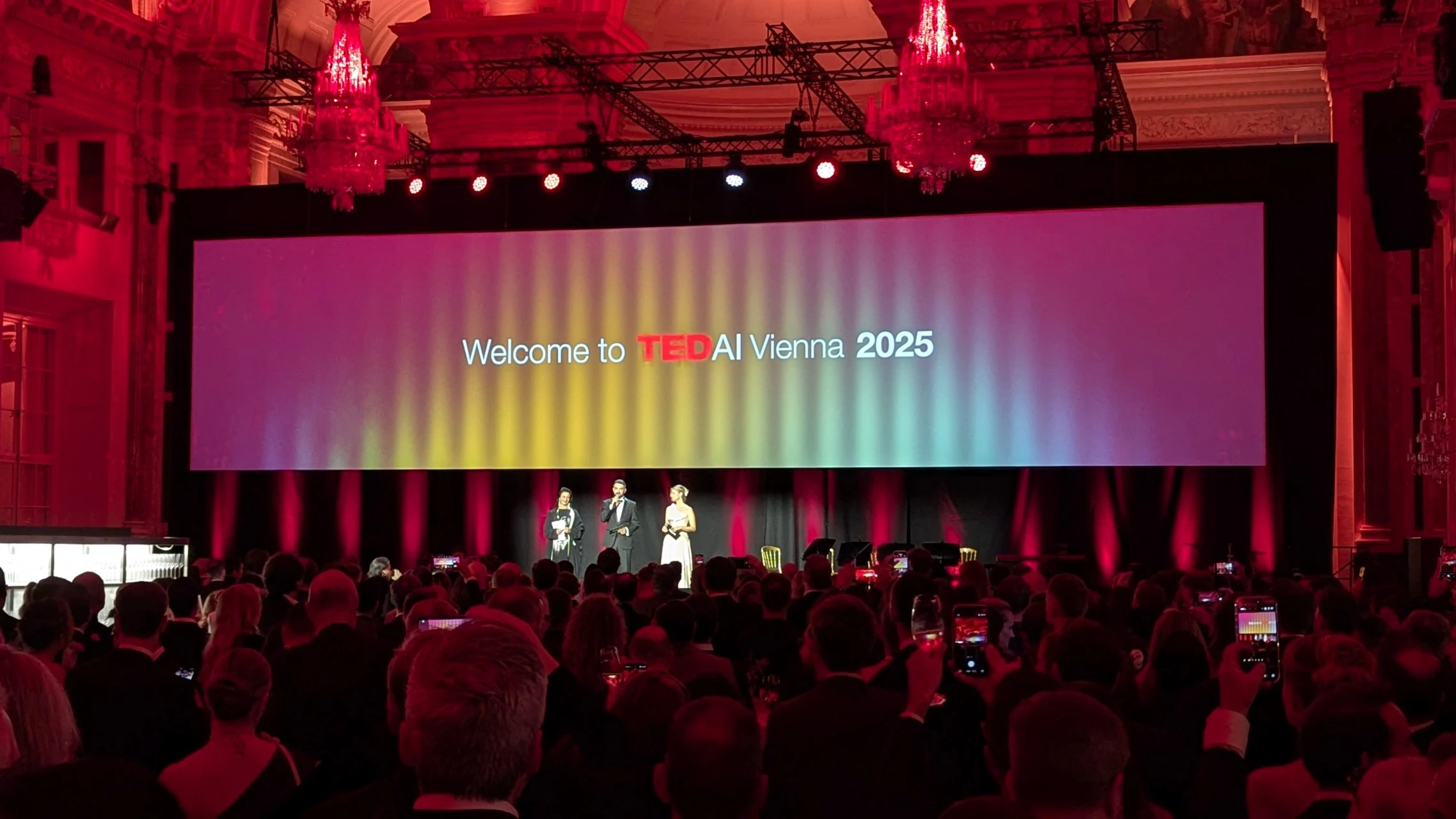
TED AI brought participants from over 50 countries to Vienna for a truly international dialogue about the future of artificial intelligence – two intensive days of insights, discussions, and practical learning.
True to TED’s promise, some talks challenged us, others inspired us, and many left us with more questions than answers. Together, they stretched our perspectives, illuminated difficult conversations and perhaps most importantly, acknowledged the cultural nuances we too often overlook in the AI dialogue.
The Central Message: New Narratives for AI
One of the most impactful moments came from Verity Harding of the University of Cambridge. Her urgent appeal: We must stop viewing AI development as an “arms race.” Instead, we should look to the space race as our model – a shared mission for humanity, not a zero-sum game between nations.
The current narrative of a race we can’t afford to lose leads to recklessness and isolation. AI is not an endpoint but a tool for progress. The focus should be on safe strategies and collaboration rather than the dangerous “first mover advantage.”
Hardy Pemhiwa from Cassava Technologies reinforced this perspective with insights from Africa, where constraints have driven innovation. The continent demonstrates how AI can overcome real barriers when technology is conceived inclusively.
Friction as Feature, Not Bug
A fascinating theme ran through multiple sessions: the significance of “friction” and “pain” in our daily work routines. Advait Sarkar (Microsoft Research), Pau Aleikum Garcia (Domestic State Streamers) and Ioana Telemann (AI-R Studio) discussed in their panel how we can protect human intention in a space of generative sameness and infinite outputs.
Their central thesis: Meaning emerges through struggle. The more friction and effort involved in a process, the greater the meaning we assign to the outcome. AI tools should therefore enhance critical thinking and metacognition, not diminish our mental capacity.
A provocative idea: What happens when you program a model so it can never give the same answer twice? Or develop a model that is missing certain concepts by default? Such constraints force both AI and humans toward more creative ways of finding solutions.
The discussion also made clear: We shape the tools, and the tools shape us. Tools are never neutral. The question isn’t whether, but how we want to continue shaping this mutual influence.
Mimirio Workshop: Context is King
Stefan Damm‘s fully booked workshop sessions on Retrieval Augmented Generation (RAG) attracted over 60 attendees. A clear signal of how relevant context-based AI solutions are for enterprises.
The core insight: Context is the key to truly useful AI. Mimirio’s approach – a knowledge database built on company data that remains entirely on company premises – generated significant interest. We don’t just keep knowledge within the company, we make it easily accessible to employees, thereby turning knowledge into actions: emails, tasks, decisions.
Enterprise agents are changing our world in general and the business world in detail. Although uncertainty and limitations exist, companies are learning fast and understanding where to apply the potential of agents to improve their business operations. This was evident in the workshop discussions, participants weren’t asking if they should implement AI agents, but how and where.
The privacy-first approach resonated strongly with participants. Particularly interesting: While security was barely mentioned in conference panels over the two days, it was a central concern in our practice-oriented workshop.
AI Transformation: Thinking in Use Cases
Multiple experts emphasized: AI transformation isn’t on the verge of coming, it’s already here. Swami Sivasubramanian from AWS put it succinctly: Developers today can focus on what they want to build, not how. Compute power has become a commodity.
The challenge for companies resembles digital transformation: Where and how to start? The answer lies in concrete use cases. PwC demonstrated this with an interactive touchscreen installation showcasing smaller and bigger use cases by industry. Also making clear, that AI has been around the block for some time now in certain fields, for example, manufacturing has been using AI for the past 10+ years.
The message: Speaking in use cases helps people understand AI’s value in their specific field of work and helps reduce fear and mental blocks.
Europe: Deliberate, Not Slow
A surprising insight from the conference: Even the industry giants don’t have a concrete end goal for AI, just vague ideas. Lukasz Kaiser from OpenAI spoke about how, after RNNs and Transformers, the next evolution will be “Researchers” – AI systems that can generate new scientific insights with less data.
Oriol Vinyals from Google DeepMind discussed the “Builder’s Dilemma”: Do you replace yourself when you build an AI scientist? His answer: No – asking the right questions remains human. AI makes science more accessible, but human input defines the direction.
Europe may appear to lag at first glance, but the conference made clear: We have strong chances as global players. Europe’s more deliberate, cautious approach considers more parameters – regulatory, ethical, societal. We’re building on others’ first steps, learning from their mistakes.
Art & Dinner
The screening of three short films by artist Afro Futcha demonstrated what’s possible with AI in a very short time – short films that have already won awards and raise the question: When knowledge is instant, what becomes of discovery?
The themed dinners offered the perfect opportunity to meet many different people from diverse contexts in a short time. The atmosphere throughout was upbeat, vibrant, and marked by a sense of momentum.
“Human in the Loop” – Heartfelt or Hedge?
One phrase appeared in almost every session: “Human in the loop.” But the question remains: Is this truly heartfelt, or just convenient insurance? The anthropomorphization of AI: when interfaces display “Thinking…” this creates trust but also leads to potential misunderstandings and misinterpretations.
Advait Sarkar‘s perspective was particularly compelling, showing an example how we can use AI within our every day work tools as a sparring partner, to create output with human in the loop already built in. This struck at the heart of what many fear about AI – that it will make us lazy, less critical, less creative.
Mercedes Bidart emphasized: the key to responsible and inclusive AI is human supervision. Bidart’s work stands as an example of ethical AI, where technological efficiency and human judgment work together to create better opportunities in the real world. She pointed out the importance that systems must meet the standards of different countries, adapt to cultural values so they can focus on local needs. In her case helping generate credit information for small business owners to facilitate micro credits in Latin America.
Our Takeaway
The key insights:
- Change the narrative: Away from arms race, toward shared mission
- Context is king: RAG technology and internal company knowledge are keys to practical value
- Build in friction: AI should challenge us, not just make things easier
- Think in use cases: Concrete applications make value tangible
- Preserve critical thinking: AI’s anthropomorphization shouldn’t deceive us – it remains a probability calculation
AI transformation is reality. But instead of being swept up in others’ enthusiasm, everyone should form their own perspective. The question isn’t whether, but how we use AI – as a sparring partner that challenges us, not as a convenient solution that does our thinking for us.
TED AI is a conference of ideas. It’s about exchange, inspiration, the spark of new perspectives. In this spirit let’s co-create with AI, collaboratively, critically and especially context-aware.
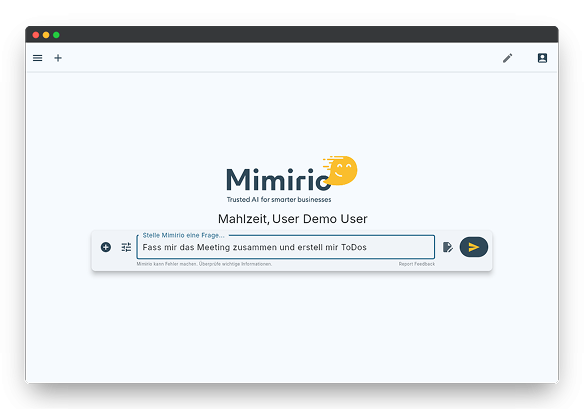
Your company’s AI brain
Interested in a knowledge database for your enterprise?
Specify your needs and contact us to learn more about Mimirio’s approach to turning company knowledge into action.